

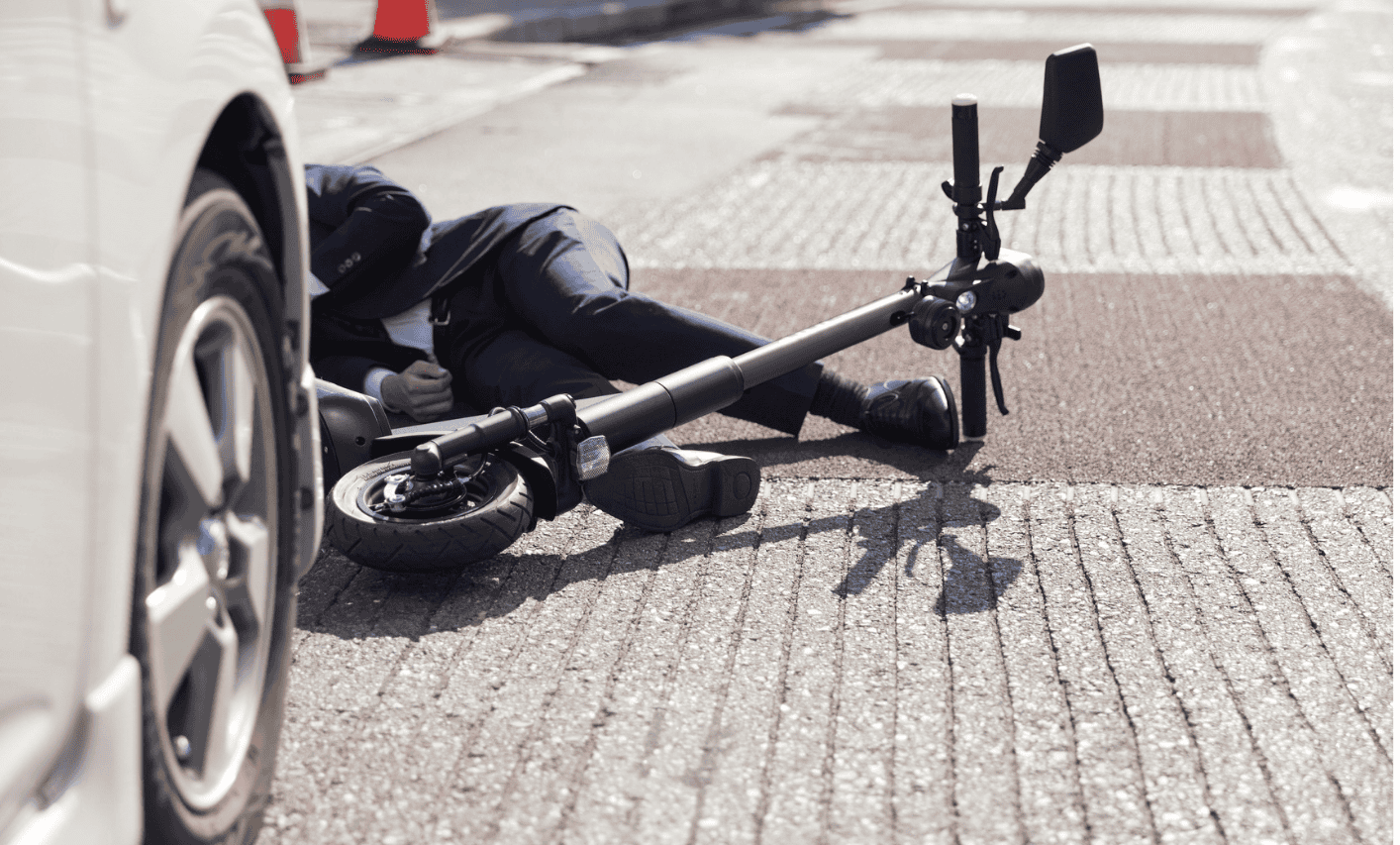

E-scooters and e-bikes are now a familiar sight on UK streets, but the law has not kept pace with them. If you have been injured in an e-scooter or e-bike accident, whether you were riding, cycling, driving or simply walking along the pavement, you may be unsure who is responsible and whether you can claim compensation.
The short answer is that you can often make a claim, but the route depends on what type of vehicle was involved. A rental e-scooter, a privately owned e-scooter, a road-legal e-bike and a modified e-bike are each treated differently in law, and that decides who pays your compensation.
This guide explains who is liable after an e-scooter or e-bike accident, how to claim, what evidence you need and how much compensation you could receive.
Are e-scooters and e-bikes legal in the UK?
The legal status of the vehicle is the starting point for any e-scooter accident claim or e-bike accident claim, because it determines which rules the rider had to follow and which insurance, if any, should be in place.
| Vehicle | Legal on public roads? | Insurance required? | How the law treats it |
| Privately owned e-scooter | No. Only on private land with the landowner’s permission | Yes, but in practice it cannot be obtained | Motor vehicle |
| Rental e-scooter in a government trial | Yes, on roads and cycle lanes within the trial area | Yes, provided by the rental operator | Motor vehicle, with some exemptions |
| Road-legal e-bike (EAPC) | Yes, on roads and cycle routes | No | Pedal cycle |
| Modified or throttle e-bike | No, unless registered, taxed and insured | Yes | Motor vehicle (moped or motorcycle) |
Privately owned e-scooters
Under the Road Traffic Act 1988, an e-scooter counts as a motor vehicle. That means it needs the same things as a car to be used on a public road: type approval, registration, tax, a licence and motor insurance. Privately bought e-scooters cannot meet these requirements, so they cannot be insured for public use.
Riding a private e-scooter on a road, pavement, cycle lane or in a public park is therefore illegal. Riders risk a fixed penalty of £300 and six penalty points for riding without insurance, further penalties for riding without a licence, and having the scooter seized by the police.
Rental e-scooter trials
The only legal way to ride an e-scooter on public roads is to use a rental scooter in an approved trial area. Trials run in parts of England and have been extended until the end of May 2028 while the government decides how to regulate e-scooters permanently.
Trial e-scooters must meet strict limits, including a maximum speed of 15.5 mph. Riders must be at least 16 and hold a full or provisional driving licence that includes category Q, although many operators set a minimum age of 18. Rental e-scooters may be used on roads and cycle lanes, but never on pavements. Crucially for compensation, every operator must have motor insurance in place.
Road-legal e-bikes
An e-bike is treated as an ordinary bicycle if it meets the Electrically Assisted Pedal Cycles (EAPC) rules:
- it has pedals that can propel it
- the motor’s continuous power does not exceed 250 watts
- the motor stops assisting at 15.5 mph
Anyone aged 14 or over can ride a compliant e-bike on roads and cycle paths without a licence, registration or insurance. In a personal injury claim, it is treated in the same way as a push bike.
Modified and throttle e-bikes
If an e-bike has a motor over 250 watts, assists beyond 15.5 mph or has a throttle that powers it without pedalling, it is no longer a bicycle in law. It is classed as a moped or motorcycle and must be registered, taxed and insured, and the rider needs a suitable licence and helmet.
This matters a great deal if you are hit by one. A modified e-bike is treated as an uninsured motor vehicle, which can open up routes to compensation that are not available for an ordinary e-bike.
Who is liable for an e-scooter or e-bike accident?
To make a personal injury claim, you need to show that someone owed you a duty of care, that they breached it, and that this caused your injury. In e-scooter and e-bike accidents, the person or organisation responsible is usually one of the following.
| Type of accident | Who may be liable | Basis of the claim |
| Pedestrian hit on the pavement | The e-scooter or e-bike rider | Negligence; riding on the pavement is illegal |
| Rider hit by a car, van, lorry or bus | The driver | Negligence and breaches of the Highway Code |
| Rider thrown off by a pothole or road defect | The council or highways contractor | Breach of the duty to maintain the road |
| Accident caused by a faulty scooter or bike | The rental operator or manufacturer | Negligent maintenance or a defective product |
Pedestrians hit by an e-scooter
The Highway Code places pedestrians at the top of the hierarchy of road users, so those riding faster, heavier vehicles carry the greatest responsibility to look out for them. Riding any e-scooter, rental or private, on the pavement is illegal, and so is cycling on the footway.
If you were hit by an e-scooter on the pavement, proving fault is rarely the difficult part. The real questions are usually who the rider was and who will pay your compensation, which we cover below.
Riders hit by a motorist
Many e-scooter and e-bike accidents happen at junctions, roundabouts and during overtaking. Under the Highway Code, drivers must not cut across riders when turning or changing lanes, and should leave at least 1.5 metres when overtaking at speeds of up to 30 mph, and more at higher speeds. Opening a car door into a rider’s path is also an offence.
If a driver caused your accident, you can claim against their motor insurer. This applies even if you were riding a private e-scooter, although your own conduct may affect the amount you receive (see below). Our guide to the Highway Code changes explains the hierarchy of road users in more detail.
Potholes and road defects
With small wheels and little suspension, e-scooters and e-bikes are especially vulnerable to potholes, sunken drain covers and broken road surfaces. Highway authorities have a legal duty under section 41 of the Highways Act 1980 to keep roads in repair.
To succeed, you must show the defect was dangerous to ordinary road users and caused your accident. Councils often defend these claims by showing they had a reasonable system of inspection and repair in place, so evidence gathered at the scene is vital. Read more in our article on cycling and potholes.
Where the rider was breaking the law, these claims can be harder. In O’Brien v Ringway Hounslow Highways (2024), a rider on a private e-scooter hit a pothole while riding along the pavement and moving onto the road. His claim failed because the court found that his illegal pavement riding was a cause of the accident.
Faulty e-scooters and e-bikes
Some accidents are caused by a mechanical or electrical fault, such as brake failure, a steering defect or a battery fire. Under the Consumer Protection Act 1987, manufacturers and importers can be liable for injuries caused by defective products, without the need to prove negligence. Rental operators must also inspect and maintain their fleets, and may be liable if they fail to repair a reported fault.
Who pays compensation after an e-scooter or e-bike accident?
Winning a claim is only half the picture; there also needs to be someone able to pay. With e-scooters and e-bikes, the paying party depends on the vehicle and whether the rider can be identified.
| Situation | Who pays |
| Accident caused by a rental e-scooter rider | The rental operator’s motor insurer |
| Accident caused by an identified rider on a private e-scooter | The Motor Insurers’ Bureau (MIB) |
| Hit-and-run by an e-scooter rider who cannot be traced | The MIB |
| Accident caused by a modified or throttle e-bike | The MIB, as it is treated as an uninsured motor vehicle |
| Accident caused by a rider on a road-legal e-bike | The rider personally, or any liability insurance they hold |
Rental e-scooter accidents
If you are hurt by someone riding a rental e-scooter, your claim is made against the operator’s motor insurance, which every trial operator must hold. The scooter can usually be identified from its fleet number or QR code, or from the operator’s GPS data showing which scooter was at the location at that time. The claim then proceeds much like a normal road traffic accident claim.
This insurance covers injuries to other people. If you were the rental rider and the accident was your own fault, it will not usually cover your injuries unless the operator offers personal accident cover.
Uninsured e-scooter claims through the MIB
Because a private e-scooter is a motor vehicle that cannot be insured, anyone riding one in public is riding uninsured. The Motor Insurers’ Bureau exists to compensate innocent victims of uninsured and untraced drivers, and it handles claims involving private e-scooters. According to the MIB, injury claims from e-scooter and e-bike collisions have passed £100 million, and rose by 73% between 2023 and 2025.
If you were injured by an identified rider, your claim is made under the MIB’s Uninsured Drivers’ Agreement. The MIB assesses fault and compensation in the same way an insurer would, and can then recover what it pays from the rider.
Hit-and-run e-scooter accidents
Many riders leave the scene before details can be exchanged. You can still claim through the MIB’s Untraced Drivers’ Agreement, but strict conditions apply:
- Report it to the police within 14 days. For injury claims, the accident must normally be reported within 14 days. Missing this deadline without good reason can lead to the claim being rejected.
- Provide supporting evidence. As there is no rider to question, the MIB will want evidence that an e-scooter or other motor vehicle caused the accident, such as witness statements, CCTV, dashcam footage or medical records.
The e-bike compensation gap
A road-legal e-bike is treated as a bicycle, not a motor vehicle, so the MIB cannot deal with claims involving one. If you are hit by a rider on a compliant e-bike, your claim is against the rider personally. Whether you recover compensation can depend on whether they have liability cover, for example through home insurance or a cycling organisation membership.
The position changes if the e-bike turns out to have been modified, with a throttle, a more powerful motor or the speed limiter removed. It is then treated as an uninsured motor vehicle, and the claim can go through the MIB. An inspection by a forensic engineer can establish this, so it is important to identify the bike if you can.
Can you claim if you were riding illegally or without a helmet?
Often, yes. Insurers and the MIB regularly argue that an injured rider’s own conduct should reduce or defeat their claim, but riding illegally or without safety equipment does not automatically mean you cannot claim.
Riding a private e-scooter: the illegality defence
If you were injured while riding a private e-scooter, the other side may argue the “illegality defence”: that the court should not compensate someone for losses arising from their own unlawful act. Courts apply this defence with care. Following the Supreme Court’s decision in Patel v Mirza [2016] UKSC 42, they weigh the purpose of the law that was broken, any wider public policy and whether refusing the claim would be proportionate.
In practice, the key question is whether the illegal riding actually caused the accident:
- Where it did not, for example where you were riding on the road rather than the pavement and a driver pulled out of a junction into your path, your claim against the driver may well succeed, although your compensation could be reduced.
- Where it did, the defence is much stronger. In O’Brien v Ringway Hounslow Highways, the rider’s claim failed because his illegal pavement riding was a cause of the accident.
Contributory negligence and helmets
Where your own carelessness contributed to your injuries, the court can reduce your compensation to reflect your share of the blame. This is known as contributory negligence.
Helmets are not a legal requirement for cyclists, compliant e-bike riders or rental e-scooter users. Even so, not wearing one can reduce your compensation, but only if the other side proves that a helmet would have prevented or reduced your injuries. Following Smith v Finch [2009] EWHC 1067 (QB), this usually needs medical and engineering evidence. If a helmet would have made no difference, for example because your injuries were to your arms, legs or body, there should be no reduction.
Compensation may also be reduced if you were riding in the dark without lights, carrying a passenger on a single-person scooter, or riding after drinking. Each case turns on its own facts, so it is worth getting advice before accepting any argument that you were partly to blame.
What evidence do you need for an e-scooter or e-bike accident claim?
The sooner evidence is gathered, the stronger your claim will be. Some of the most useful evidence disappears within days.
| Evidence | Where it comes from | Why it matters |
| Police report and reference number | The police | Records the accident and is required for an untraced (hit-and-run) claim |
| CCTV and dashcam footage | Councils, shops, buses, drivers | Shows what happened; often deleted within days or weeks |
| Rental app and GPS data | The e-scooter operator | Identifies the scooter and rider and shows speed and location |
| Photographs | You or witnesses | Records the scene, any road defect, the vehicles and your injuries |
| Witness details | People at the scene | Independent support for your account |
| Medical records | GP, A&E and specialists | Show the injuries and treatment |
| Engineer’s inspection | A forensic engineer | Confirms whether an e-bike was modified or a vehicle was faulty |
Steps to take after the accident
- Get medical attention, even if your injuries seem minor at first.
- Report the accident to the police and note the reference number.
- Take photographs of the scene, the vehicles, any road defect and your injuries.
- Collect the names and contact details of witnesses.
- Note any cameras nearby and ask for footage to be saved as soon as possible.
- If a rental scooter was involved, note its fleet number or QR code.
- Keep receipts for any expenses and a record of time off work.
- Avoid posting about the accident online, as it can be used against you (read our article on how social media can affect your personal injury claim).
A solicitor can write to councils, businesses and rental operators straight away asking them to preserve footage and data before it is deleted. For more guidance, see what proof do I need to make a personal injury claim?
Time limits and funding your claim
How long do you have to claim?
You normally have three years from the date of the accident to start court proceedings for a personal injury claim. If you only became aware of your injury later, the three years may run from the date you found out.
There are two important exceptions:
- Children. If the injured person was under 18, the three years do not start until their 18th birthday, so they have until they turn 21. A parent or guardian can bring a claim on their behalf before then.
- Loss of mental capacity. If the injured person lacks mental capacity, for example after a serious brain injury, the time limit does not run while they lack capacity. A litigation friend can bring the claim for them.
Even where you have time, it is best to act quickly. Evidence such as CCTV, rental app data and witness memories fades fast, and for hit-and-run claims the police must normally be told within 14 days.
No win, no fee
Most e-scooter and e-bike accident claims are funded through a conditional fee agreement, often called no win, no fee. You pay nothing upfront, and if your claim is unsuccessful you will not normally pay your solicitor’s fees.
If your claim succeeds, a success fee is deducted from your compensation. By law, this is capped at 25% of your general damages and past financial losses. Insurance can also be taken out to protect you against the other side’s costs and expenses such as medical reports if the claim does not succeed. We will explain all the options clearly before you decide.
E-scooter and e-bike accident claims: frequently asked questions
Can I claim compensation if I was hit by an e-scooter?
Yes. If you were hit by a rental e-scooter, you can claim against the operator’s insurer. If you were hit by a private e-scooter, or the rider fled the scene, you can usually claim through the Motor Insurers’ Bureau.
Can I claim if I was injured riding a private e-scooter?
Possibly. Riding a private e-scooter in public is illegal, but if someone else, such as a careless driver, caused your accident, you may still be able to claim. Your compensation could be reduced, and the claim may fail if your illegal riding itself caused the accident.
Who pays if the e-scooter rider was uninsured?
The Motor Insurers’ Bureau compensates people injured by uninsured motor vehicles, which includes private e-scooters ridden in public.
What if I was hit by an e-bike?
If the e-bike was road legal, your claim is against the rider personally, and the MIB cannot help. If it had been modified with a throttle or a more powerful motor, it is treated as an uninsured motor vehicle and you may be able to claim through the MIB.
Will not wearing a helmet stop me claiming?
No. Helmets are not compulsory for cyclists, compliant e-bike riders or rental e-scooter users. Your compensation may be reduced, but only if the other side proves a helmet would have prevented or reduced your injuries.
How long do I have to make an e-scooter accident claim?
Usually three years from the date of the accident. For children, the three years start on their 18th birthday. For hit-and-run accidents, report the incident to the police within 14 days.
How Gorvins can help with your e-scooter or e-bike accident claim
E-scooter and e-bike accident claims can be more complicated than a typical road traffic claim. Identifying the vehicle, the rider and the right insurer or MIB agreement early can make the difference between a successful claim and no recovery at all.
Our personal injury solicitors act for pedestrians, cyclists, e-bike riders and e-scooter users injured on the road. We can secure the evidence quickly, deal with insurers and the MIB, arrange rehabilitation and fight for the full compensation you are entitled to, usually on a no win, no fee basis. Where injuries are serious, including head and brain injuries, our specialist team will guide you through every stage.
To talk through what happened, call our personal injury team on 0161 930 5151, email enquiries@gorvins.com or contact us online and we will call you back.